
Electric Bikes and Scooters in Paraguay: A Practical Buying Guide
An electric bike or scooter bought in Paraguay can be good value if it fits your journey, uses a replaceable battery, and still saves money after transport and after-sales costs. Without those conditions, an attractive shelf price can leave you with a vehicle that becomes unusable after one component fails.
Ciudad del Este offers machines in many styles and specifications. Two outwardly similar models may use very different cells, controllers, brakes, frames, and folding mechanisms. Advertised range and peak motor output are not enough to make a sound choice. Start with the journey and finish with a test of the actual unit.
Match the vehicle to your route
Record daily return distance, hills, road surface, rider and luggage weight, rain exposure, and secure-storage options. Decide where charging will take place and whether the vehicle must be carried upstairs, placed in a lift, or loaded into a car. These practical limits should determine size, battery energy, wheel choice, and weight.
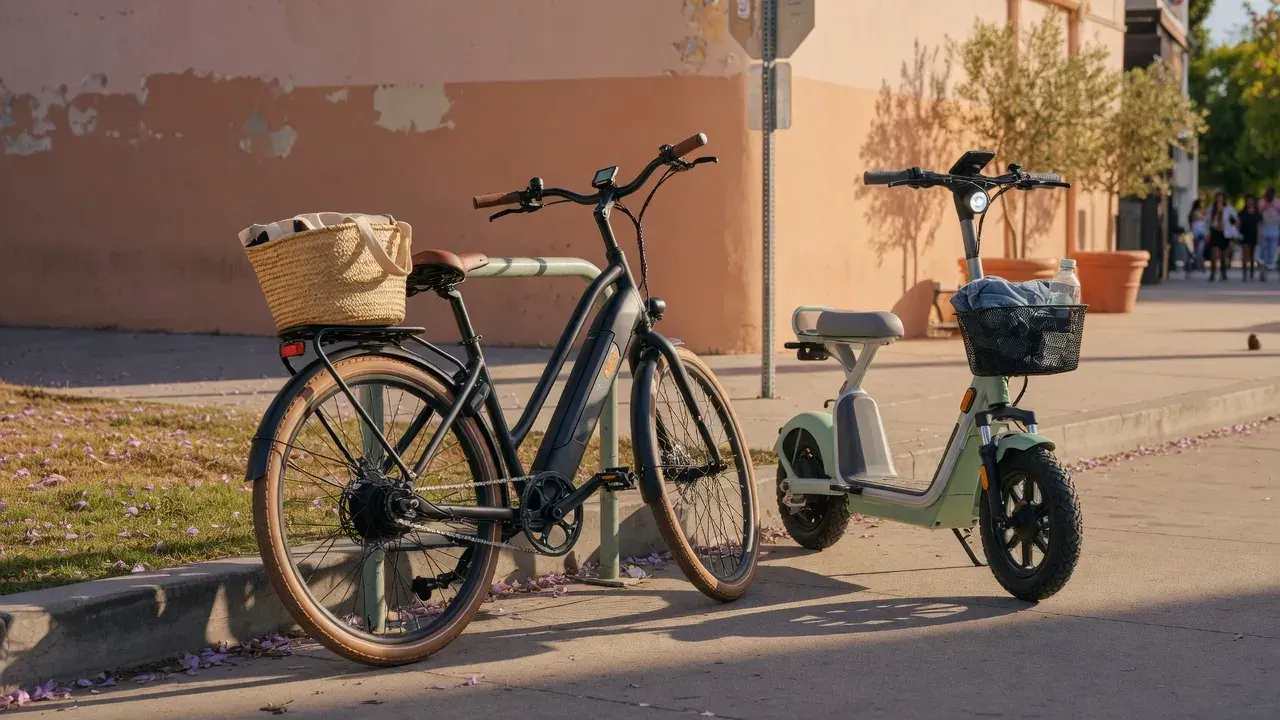
An electric bike lets you continue under pedal power and may suit longer journeys. A scooter is compact, but small wheels react sharply to rough ground. If portability matters, lift and fold the actual machine.
Check maximum load, bike frame size, handlebar height, riding position, and saddle adjustment. Include clothing and baggage in the load rather than counting the rider alone. For everyday transport, stable handling, comfort, and predictable braking are generally more useful than an eye-catching top speed.
Understand the motor and assistance system
Record continuous or nominal power separately from peak output. Peak power may be available only briefly and does not describe continuous operation. On an electric bike, ask how pedal assistance is detected. A cadence sensor identifies crank movement, while a torque sensor measures effort and will often produce a more proportional response. Programming quality also affects how either system feels.
Check assistance levels, throttle operation where fitted, motor cut-off under braking, and the information shown on the display. During a controlled test, note whether assistance begins progressively and stops immediately when required. Abrupt drive can be difficult to manage on wet surfaces or in confined areas.
Hub motors and mid-drive motors differ in handling and maintenance, but neither is automatically best. It is more important to identify the motor, controller, and display and establish whether replacements exist. Proprietary connectors or software can prevent an apparently similar component from working.
Road-use classification and operating conditions may vary by location and vehicle specification. Consult official sources for the place where you intend to ride and for any international journey. Do not regard a retailer's description as legal confirmation.
Compare battery capacity and realistic range
Ask for battery voltage and amp-hour capacity. Approximate nominal energy is Wh = V × Ah. Watt-hours are useful for comparing stored energy, but they do not guarantee distance. Rider weight, speed, hills, wind, temperature, tire pressure, stops, and assistance level all affect range.
Request the conditions behind any range estimate. A figure achieved with a light rider on level ground and low assistance will not represent a loaded, hilly commute. Plan a reserve rather than relying on the final segment of the display.
Find out whether the battery is removable, how it locks, its exact code, and whether a genuine replacement is available. Ask about the cell type where documented, battery-management system, storage procedure, and separate warranty terms. “Lithium battery” alone provides too little information about compatibility or future support.
Inspect the casing for swelling, cracks, severe impact marks, moisture, scorched contacts, or repairs. It should fit and lock without abnormal movement. During the test, watch for errors, sudden gauge changes, or power cuts under load. A short ride cannot measure full capacity, but it can reveal poor connections and immediate faults.
Heat, deep discharge, and unsuitable storage accelerate deterioration. Follow the manual, use the specified charger, and do not charge with damaged cables or beside readily combustible materials. Carrier conditions for lithium batteries may vary by route and transport method, so obtain confirmation before carrying or shipping the vehicle.
Charger, plug, and system compatibility
Read the charger label for model, input range, frequency, output voltage, current, and connector. Its output must match the battery specified by the manufacturer. A connector that physically fits does not prove correct polarity, voltage, or communication. Never experiment with an unidentified charger.
A plug adapter does not convert voltage. Confirm that the input accepts the electricity supply at the charging location. Ask how long a normal charge takes, how faults are indicated, and whether an approved replacement charger is available. If you need a second charger, verify its exact compatible code.
Check whether keys, battery locks, an account, or an application are required for activation. Make sure all credentials pass to you and that essential functions do not depend on a service unavailable in the country of use.
Brakes, tires, structure, and wear parts
Identify the brake type and operate each control separately. Mechanical or hydraulic brakes may be fitted; electrical regeneration, where present, is supplementary and does not replace functional mechanical brakes. Feel for a firm, controllable response and listen for excessive rubbing or unusual noise.
Record tire size, recommended pressure, and whether tubes are used. Establish local availability before buying. Inspect rims, spokes, axles, fork, stem, handlebar, and welds. On a folding scooter, check the hinge and locking mechanism for movement. On a bike, examine chain, gears, cranks, pedals, and wheel alignment.
Accessories cannot compensate for structural defects. Ask where to obtain brake pads, tires, display, controller, motor, and folding parts. An untraceable model can be disabled by one unavailable item.
Calculate total ownership cost
Use this formula:
total cost = vehicle + assembly and adjustment + helmet and necessary protection + lock + travel and transport + currency and payment fees + any applicable declaration or tax + essential accessories + initial servicing + battery reserve + likely warranty cost
Add professional assembly if the product is boxed. To compare it with public transport or a car, estimate monthly cost over your intended ownership period, including tires, brakes, and gradual battery-capacity loss. A rechargeable battery is a wear component; do not assume first-day range will remain unchanged indefinitely.
For a dedicated journey to Ciudad del Este, count the entire trip and the logistics of a large, heavy package. Measure your boot, lift, doors, and storage area. Confirm packaged dimensions and weight. Check current requirements with authorities and carriers before crossing a border.
Test and inspect before payment
Match identifiers on the frame, motor, battery, and box where provided. Ask for the invoice or order to state the brand and model. Look for impact damage, corrosion, disturbed fasteners, pinched cables, loose connectors, and parts that differ from the agreed specification.
Test in a safe, permitted area. Begin without assistance to assess steering, wheels, and brakes, then use the lowest power level. Check start-up, brake cut-off, display, lights, and assistance settings. Listen for knocks, scraping, and irregular motor noise. A misaligned handlebar, oscillating wheel, weak brake, or loose folding joint should not be dismissed as normal.
Verify the correct charger, keys, manual, tools, pedals, reflectors, and promised accessories. If the machine is not fully assembled, obtain instructions and have assembly completed and checked before riding.
Invoice, warranty, and service support
The invoice should identify the seller, date, currency, total, brand, and model, with the serial number where possible. Obtain written terms for frame, motor, controller, display, battery, and charger because coverage may differ between components.
Ask where diagnosis takes place, who pays transport and labour, and whether support exists in the destination country. Confirm that a workshop can interpret system errors and obtain parts. A verbal promise of immediate replacement is not a reliable warranty process.
Keep delivery photographs, labels, receipt, manual, and the agreed specifications. Do not open the battery or controller yourself. Apart from electrical danger, unauthorised intervention may complicate warranty assessment.
Red flags
- Range is promised without stating rider weight, speed, or assistance mode.
- Only peak motor output is disclosed.
- Battery and charger lack readable model labels.
- No one can identify a replacement battery.
- The charger fits, but output and polarity are not confirmed.
- Brakes, steering, or folding mechanism have play.
- The retailer prevents a basic test or inspection of identifiers.
- Activation depends on an account that is not transferred.
- Warranty terms name no responsible provider or location.
- The invoice describes only an “electric vehicle.”
Related guides
- Shopping in Ciudad del Este
- Buying electronics in Paraguay
- Buying tools in Paraguay
- Buying tires in Paraguay
Conclusion: when the purchase makes sense
An electric bike or scooter from Paraguay makes sense when it suits the route, passes a test, has an identifiable battery, uses a compatible charger, and comes with obtainable parts and complete documents. Transport, protection, assembly, maintenance, and support all belong in the calculation.
If range is an unexplained promise, no replacement battery exists, or each fault requires a disproportionate journey, the initial saving is fragile. Prioritise a machine you can ride, charge, stop, and maintain safely over the long term.